


Inside Louis Vuitton’s Barcelona flagship, former staff say the line between legitimate shoppers and Chinese resale gangs has long been blurred — with many sales driven by the so-called “parallel trade” designed to funnel luxury goods from the West to China for profit. China’s high-volume, high-pressure market for luxury handbags is fed by Daigou, informal resale networks that exploit Europe’s tax-free shopping system, which take advantage of higher prices and poor availability in China.
Earlier this year, Dark Luxury exclusively revealed a first-hand account of a tourist who was hired by a Daigou gang to illicitly buy Louis Vuitton bags in the Barcelona store, so that they could be smuggled back to China for resale. Since then, former members of staff have come forward to share with Dark Luxury what it was like to work there, and explain why they believe the brand enabled the problem rather than confront it. Sales from Daigou trading are a feature of the Louis Vuitton retail operation in Europe, not a bug.

Bernard Arnault, the chief executive officer of LVMH which owns Louis Vuitton, said the company is “refusing and fighting against so-called parallel exports” on a January 2023 company earnings call, and he criticised other luxury firms who he says sell through resellers. The company’s then-chief financial officer, Jean-Jacques Guiony, said on the same call that the company “deliberately decided to contain or indeed delete all parallel channels”.
Dark Luxury approached Louis Vuitton for comment on this story, and had received no reply by the time of publication.
The staff who worked there describe a toxic work culture marked by fear and contradictory policies around Daigou traders. On the one hand staff were given instructions not to serve these customers and guidance on how to spot them. On the other, managers allegedly berated and shouted at staff, punished those who questioned store policies, and demanded that employees serve aggressive Daigou shoppers. The numbers involved are huge. One ex-employee said these customers could easily account for more than a third of the store’s annual sales, which they estimate exceed €100 million. There is no suggestion that Louis Vuitton is deliberately circumventing tax regulations or endorsing criminal behaviour in its shops.
Dark Luxury offer
We have some ambitious goals and we need more paid subscribers to help fund our journalism. We’re offering 20 per cent off annual subscriptions for the rest of May to celebrate passing 1,000 subscribers. We hope you’ll consider supporting us.
Dark Luxury spoke to former salesperson Alma Attias, who claims she was dismissed after being falsely accused of accepting bribes from Daigou clients. She says her firing was not about compliance, but about control — a warning to others to stay silent and submissive to bullying management — and to continue turning a blind eye to the Daigou gangs.
Her story, which we detail below, offers a rare glimpse behind the polished facade of a global luxury brand, and reveals what can happen to those who challenge the system from within.

Each morning at Louis Vuitton’s store on Paseo de Gràcia, Alma Attias says she braced herself for long queues of customers – many of whom worked for Chinese resale networks. Sales targets were high, questioning instructions was discouraged, and managers, she says, were quick to punish staff who pushed back.
“It was like this from the very beginning”, said Attias, speaking to me in the Cotton House Hotel, a 15 minute walk from the store where she used to work between late 2022 and June 2023. “Even during training in Madrid, we were told all of this”, she said, referring to the prevalence of parallel trading — where shoppers, often part of so-called Daigou gangs, buy luxury goods in Europe to resell for profit in China.
Attias and another former member of staff at the Barcelona store who wished to remain anonymous describe a sales environment dominated by these transactions. “In my experience, all of them were parallel”, Attias said. “I never assisted a Chinese client who wasn’t”. She claims that many of the shoppers used borrowed passports and false identities to get around the company’s sales limits, which were designed to stop the parallel trade.
“They would wear face masks. Or they would say, ‘my cousin’s coming’. And then a random person would turn up. They would try to use different passports”, she said.
Louis Vuitton’s system was supposed to flag these tactics. Clients were restricted to buying three handbags per day, six per week and 12 per year. But staff say those rules were easy to bypass. “There were these messages that were supposed to show up [on the store’s iPad sales system], but that never really happened”. Even when a customer was flagged by the system as a potential parallel trader, the manager would approve the sale anyway.
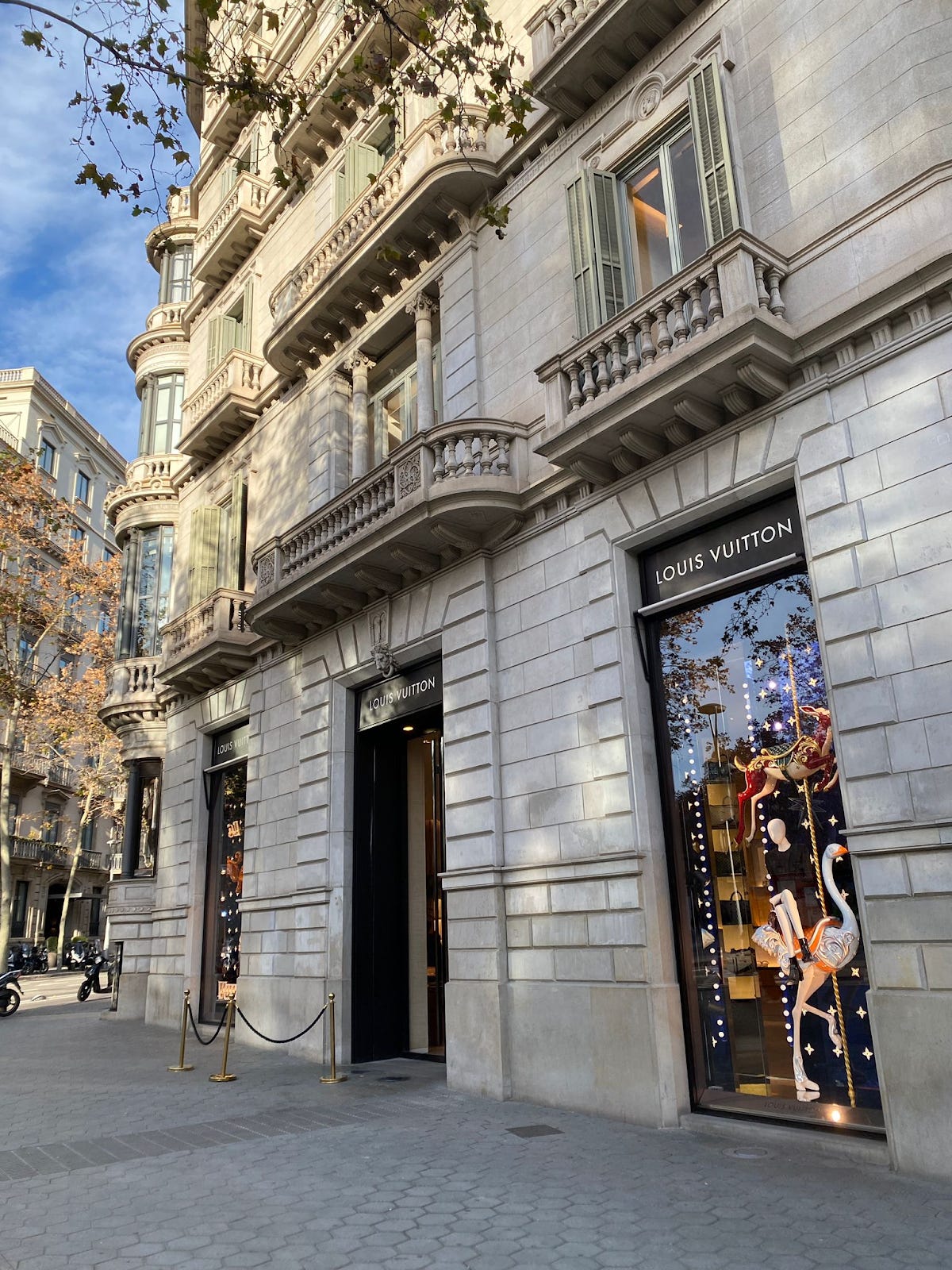
At the height of the post-pandemic luxury sales boom in 2023, Attias and a former colleague said the store routinely brought in between €300,000 and €500,000 per day — a large share of it through parallel traders. “No one wanted to assist them”, Attias said, “because you wouldn’t get any commission, and you could get into trouble”. Daigou used various tactics to avoid arousing suspicion. They always bought lower value bags and always used cash. Every transaction was below a total value of €10,000, which avoided stricter scrutiny. Despite these telltale signs, managers would assign sales staff to sell to Daigou shoppers regardless.
‘Sometimes they would get angry, so the manager would then approve [the sale]’
Some of the parallel shoppers became confrontational when denied a sale, according to Attias, and managers often stepped in to smooth things over. “Sometimes they would get angry, so the manager would then approve [the sale]”, she said.
Attias isn’t the only one to speak out. Her former colleague said: “I believe that’s the dichotomy between, on the one hand, the parallel traders giving [Louis Vuitton] money. On the other hand, it’s a black market. Why are you explaining to the workers that you shouldn’t sell to the Daigou, but they encourage them to do so? It was all very confusing”.
Attias and other staff who raised concerns about the parallel traders faced retaliation from management. “We were the kind of people who spoke up”, said the colleague. In Attias’s case, the response was swift.
Screenshots from the letter Louis Vuitton sent to Attias listing transactions which the store says were made by parallel traders. The store lists 23 transactions over a five week period in April and May 2023, with a rough value of €45,300, giving some idea of the scale of the trade at that time.
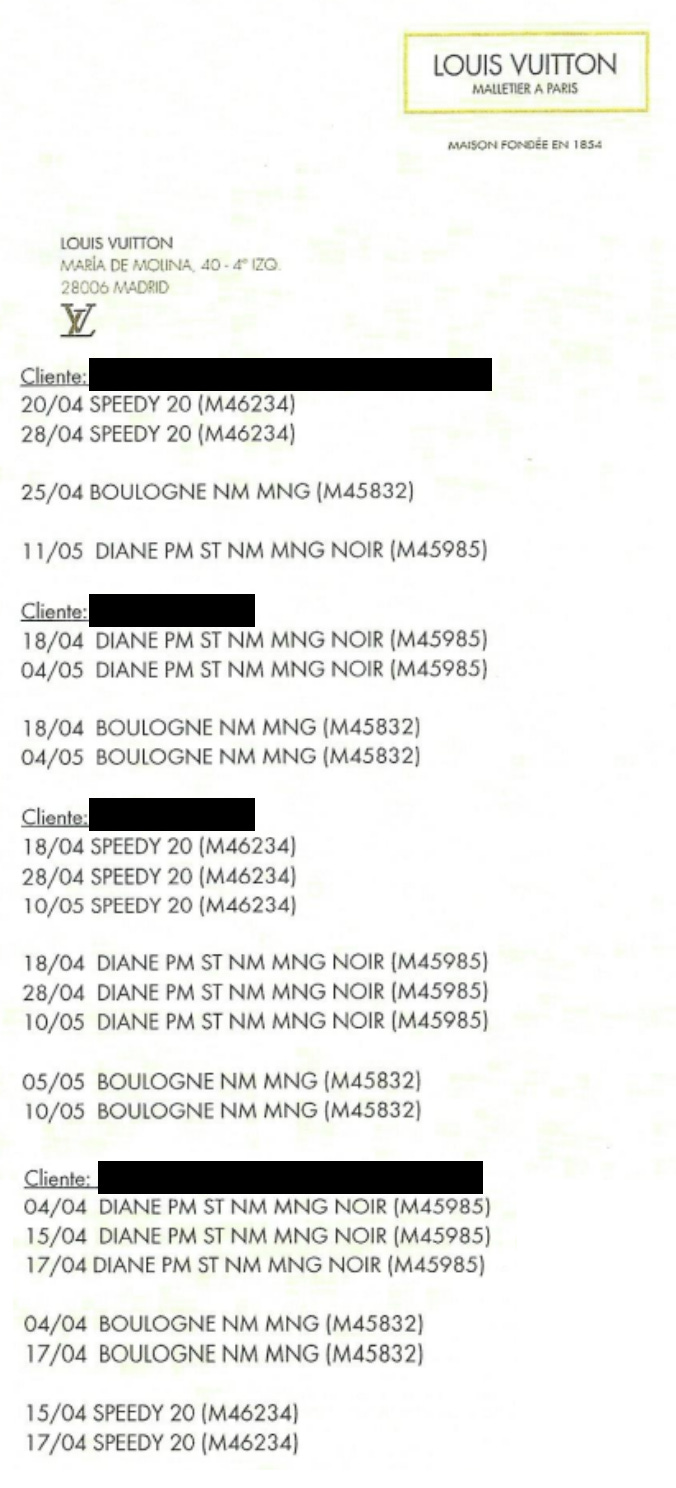
In late June 2023, Attias was fired. In a letter from Louis Vuitton, the company accused her of misconduct, including favouring certain clients, neglecting others, and most seriously: accepting bribes from Chinese clients who wanted to secure access to limited-edition handbags.
Attias denies the charges. She claims her dismissal followed months of tension with store leadership, including what she describes as harassment by her direct supervisors. “I was being harassed”, she told Dark Luxury. In a formal written rebuttal to Louis Vuitton’s allegations, she stated, “I have never accepted bribes”, and said she had been the subject of “repeated and systematic harassment, mistreatment, disrespect, and abuse of power” from her direct line manager and other managers at the store.
She acknowledges that some clients gave her small gifts such as cake, flowers and lip balm, but says these were always disclosed to management and were well below the informal €100 value that staff understood to be acceptable.
Attias disputed her firing, but the dispute never reached a full trial. In a pre-court arbitration process, Louis Vuitton offered Attias a settlement. Her lawyer told her this was a common approach. Companies such as Louis Vuitton in Barcelona sometimes used false allegations to justify termination, knowing the cases would likely settle.
Despite what she says were false allegations against her and her abrupt exit, Attias looks back on her time in the store with mixed feelings. “The Louis Vuitton experience was a good experience”, she said. “The team was amazing. There was camaraderie there. But if it hadn’t been for them, it would have been a zero out of 10 experience. The management team was just dreadful”.
Attias no longer works in retail. Not long after her dismissal she was diagnosed with a stress-related illness. “Retail is all about stress”, she said. “Even if I wanted to go back, I shouldn’t”. She is hoping to move into a more creative career, perhaps involving flowers, or something that taps into her passion for vegan food.
Louis Vuitton may not often appear in headlines alongside organised crime, but for staff in Barcelona the overlap was impossible to ignore. Attias’s story shows what happens when luxury brands leave an opening for criminals to move in, and what it costs the staff when management turns a blind eye. The price isn’t paid by the brand. It’s paid by people on the shop floor, by people like Alma Attias.
Did you find this newsletter useful or interesting? Please forward it to a friend or colleague, or share your thoughts with us on Bluesky or on Instagram.
