Why does the ‘King of Cashmere’ sell so many plastic clothes?
Six questions for the ‘gloriously potty’ Italian billionaire fashion company founder Brunello Cucinelli and the press who cover him
Imagine for a minute a British or American billionaire chief executive made a two-hour long film about himself with the title “Businessman X: The Compassionate Titan”.
A documentary biopic, ponderously shot with slow mo and soft hues by a renowned film director known for his heartfelt saccharine stories, it tells the story of how the billionaire saved the life of a sex worker, how he considers himself more of a “philosopher” than a businessman, and, preposterously, borrows a plot device from a 1950s Ingmar Bergman film.
Imagine further that President Trump or Prime Minister Keir Starmer came to the premiere of the film wearing the billionaire’s product, where no independent critics were invited, and the journalists in attendance were plied with champagne on the company’s dime, and who then wrote glowing stories about said billionaire.
Imagine further still that the billionaire, whose company turned over more than $1 billion last year, managed to get taxpayers to pay for a chunk of the film’s production costs while the government in question cuts back on subsidies for film productions where the money is legitimately needed.
You’d hope that the potential press reaction in the UK to that kind of a thing would prevent a billionaire founder from thinking of doing any of that.
And yet, that is more or less what has just happened in Italy.
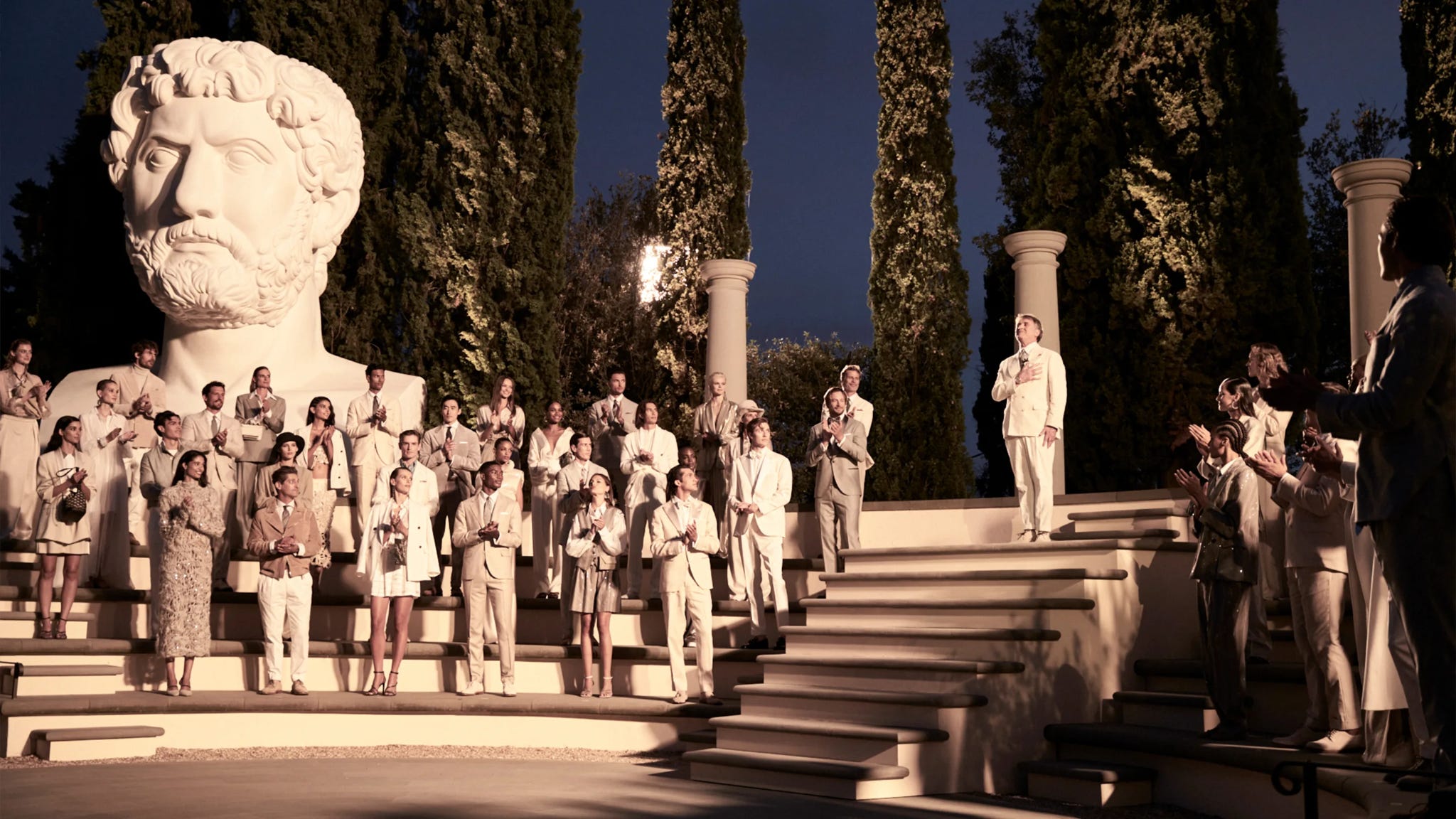
The billionaire is Brunello Cucinelli, whose eponymous company makes expensive woolly jumpers, and the film is Brunello: The Gracious Visionary, dir. Giuseppe Tornatore of Oscar-winning Cinema Paradiso fame. This expensive, partially taxpayer-funded puff piece and the largely uncritical reaction to it made me want to look a bit further into this “gloriously potty” man, as one journalist who’s interviewed him described him, and his company. You only need to take a two minute-long look at the website (SEO strapline: “Philosophy, Online Boutique & Investor”) which features quotes from Kant, philosophical tracts on AI and photos of Brunello at the UN, to understand why.
Here Dark Luxury asks six questions of Brunello Cucinelli and his company, and the people who cover him.
Why is the fashion press so uncritical of this company and man?
How did the company get the Italian taxpayer to pay for part of a glorified advert?
Why does Brunello Cucinelli still have a boutique in Moscow’s Red Square?
Why does the “King of Cashmere” sell so many plastic clothes?
Why are unions banned at Brunello Cucinelli?
Is Brunello Cucinelli really that gracious?
1) Why is the fashion press so uncritical of this man and his company?
Anyone considering whether or not to watch Brunello: The Gracious Visionary when it reaches cinemas and streaming platforms later this year will not find anything approaching a critical review of the film from the people who saw it at at the premiere. We had to look quite hard to find real reviews of the film, because most of the coverage was more focused on the cocktails at the afterparty.
According to reviews from GQ, Vogue and Esquire, the film is a monument to Cucinelli, but none of them actually say if the film is actually any good. In fact, they’re all very careful to say as little as possible about the celluloid. GQ Global Fashion correspondent Samuel Hine describes it as a “lavish and at times poignant bildungsroman”, and says Cucinelli emerges from a Gobi Desert dust storm on horseback in the film, like a “cashmere cowboy riding into town”. His report, like that of Vogue (“Brunello Cucinelli can now add ‘actor’ to his already encyclopedic résumé”), Esquire (“A breathtaking… biopic”), centres on the celebrities, tech CEOs and politicians invited to the premiere. Not to mention the brand of champagne served (Krug), and the detail that Cucinelli humbly shipped in 100,000 books from his personal collection to surround the dining hall at the premiere.
You have to search for some very specific Italian-language reviews for anything approaching a fair critique.
“Cucinelli’s story seems almost too ‘good’ to be true. Almost as if it were a hagiography of a saintly martyr from centuries past”, writes Federico Sagheddu of Rome-based DassCinemag. “The plot, in itself very linear and flat, is unengaging. Our ‘hero’ almost never seems cornered by anything”, and while the cinematography and style of the film gets some praise, ultimately Sagheddu thinks the film is full of “weak, rhetorical, and pompous narratives”. He also points to comments under the YouTube trailer, which describe the film as a “personalised commercial” or a “Berlusconi-style rebranding”. Eugenio Grenna, writing for the National Union of Italian Film Critics publication Sentieri Selvaggi, describes the film as a “chaos of images, sensations, and words barely contained”. A mess, in other words.
Most pointedly, Lorenzo Pedrazzi of ScreenWEEK writes, “At the end of Brunello, the Gracious Visionary, one has the impression of having watched a long and expensive commercial for the Brunello Cucinelli Boutique”. Which raises another good question.
2) How did the company get the Italian taxpayer to pay for part of a glorified advert?
As reported by Thomas Mackinson in Il Fatto Quotidiano, this “commercial for Cucinelli was financed with a €4 million tax credit from the Italian government, plus co-production support from Rai Cinema, also publicly owned. This, for a company which closed 2025 with over €1 billion in revenue. “It clearly didn’t need public support for a self-celebratory project”, Mackinson told me over email.
“This funding… is even more curious given that the Italian prime minister and the current government [under Giorgia Meloni] have loudly criticised what they call excessive public subsidies for cinema. And yet not only did they fund this autobiographical film by a ‘friendly’ designer, but the PM also attended the premiere wearing Cucinelli clothes”, he added.
The fashion press, dependent on advertising revenue from brands like Cucinelli, is incentivised to participate in the myth-making. They report on the celebrity guest list and the drinks, functioning as an extension of the brand’s PR and marketing apparatus.
Only independent critics like Il Fatto Quotidiano are free to point out that a billionaire’s puff piece film isn’t very good, or to question if getting €4 million in tax credits to make a two-hour advertisement should be allowed. Brunello Cucinelli is a visionary, of course. He’s a visionary businessman who has wrapped himself in a cloak of pompous, philosophical branding which apparently is enough to fool princes, DiCaprios and DeNiros.
3) Why does Brunello Cucinelli still sell jumpers in Moscow’s Red Square?
Brunello Cucinelli touts its “Idea of Humanistic Capitalism and Human Sustainability” firmly on the website, describing the founder’s dream of having a business “to make profits ethically”. What’s missing is any explanation of the ethics of continuing to operate in Russia years after the country’s illegal invasion of Ukraine and the EU introduced sanctions on exporting luxury goods to the country.
At the time of the invasion, tens of thousands of Western brands halted their operations, selling up or just shutting down. The EU introduced a law banning exports of luxury goods worth more than €300 to Russia. In September 2025, a short report alleged that the brand was still operating in the country, and that the company was using Russia to sell off old stock. The story, repeatedly denied by the company, drove a near 20 per cent decline in the share price. In a statement at the time, it said it continued to operate there to ensure salaries for workers.
CEO Luca Lisandroni told the FT in relation to an earlier report by a London-based hedge fund that the company’s boutique were shut, but staff carried out one-on-one sales, and that its “activities are based on shipments within the price limits allowed by the EU”. A few weeks ago, the company very quietly and vaguely said it had tightened its controls on sanctions compliance, mentioning this on page 37 of an 86-page long report.
Brunello Cucinelli can more than afford to stop selling jumpers in Red Square, so why doesn’t it? Perhaps we could lean on the thoughts of one of Cucinelli’s favourite philosophers, Immanuel Kant, who would likely argue that obeying only the precise letter of the EU sanctions law, while continuing to profit from a regime enabled in an illegal war, fails any reasonable test of moral duty.
The stock market is not known for following philosophical beliefs, but there is some evidence that traders can see the costs of this hypocrisy. The company’s share price is yet to recover to the price it was before the short report containing the Russia allegations, despite rising sales volumes.
Ukrainians can also see this very clearly. In early December, a small group of Ukrainian activists held up banners outside the London store in protest at the brand’s continued operations in Russia, claiming the business “costs lives”.
4) Why does the ‘King of Cashmere’ sell so many plastic clothes?
Now let’s talk about jumpers. Brunello Cucinelli is often referred to as the “king of cashmere”. So why are so many of his clothes made of synthetic materials? We analysed all the women’s clothes which Brunello Cucinelli sold back in October, and found that nearly half of them, or 200 of the 405 items we scraped, are partially made of oil or recycled wood pulp.
Of those, 32 of them (selling for an average price of £2,152 per item) were mostly made of synthetic materials, acetate, elastane, nylon, polyester, polyurethane and viscose (which is technically a semi-synthetic, since it’s made of pulped wood).
This is arguably the kind of thing you might expect from a high-street fast fashion retailer like Zara or H&M. Only about a third of the women’s line include any cashmere, and only 43 items are 100 per cent.
Brunello Cucinelli is not the only high-end luxury retailer to sell plastic items for natural prices. However, we found it odd that some items do not disclose this clearly upfront to customers.
Several items put the “natural” materials first in the name, and hide the synthetics on a drop down tab on the website. Like this £2,600 “soft wool, cashmere and mohair dazzling rib cardigan”, which is in fact nearly half synthetic, made up of 26% nylon and 19% polyester materials.
Some of the items disclose the synthetic materials in the name online (like the £6,100 “Silk and acetate crêpe cady halterneck dress with precious beaded collar”, which is 52 per cent acetate), and you’d probably expect plastic in the various “techno” or “outwear” branded items.
But then there’s this £4,600 “Virgin wool, cashmere and mohair balloon net embroidery cardigan with hood”, which is 23% nylon and 13% polyester.
And do people know that more than a third of this £17,500 “Dazzling croc embroidery dress in mohair, silk and linen” is made of plastic? Put the sequins down, Brunello.
For fairness, we did a similar scrape of equivalent items on Loro Piana’s website, and found that while this LVMH-owned brand does use synthetics in many of their clothes, the total percentage of the range which uses them is much lower. Just 16 per cent, or 25 of the 152 items, had some synthetic element and most of those were technical clothing items which disclose their artificial materials up front. Which raises the question, if Loro Piana can do it, why can’t Brunello Cucinelli?
5) Why does Brunello Cucinelli not allow his workers to unionise?
Using synthetic materials can sometimes be a way to cut costs. The other major element of the cost of a luxury clothing item is often making the thing. Here, Brunello has some talking points.
“Cucinelli pays his employees about 20 per cent more than the manufacturing industry average”, reports a Panorama interview in 2016, and another in 2018, and 2019 and 2025 and so on. It does appear to be true that Cucinelli pays factory workers better than average, amounting to a couple of hundred euros extra a month. The Western press, on their frequent pilgrimages to Solomeo, the headquarters of the company, also often tout things like how workers get 90 minute lunch breaks and are not subject to timecards.
What you do not get as a worker at Cucinelli is the right to organise. In 2011, CGIL Perugia, a branch of Italy’s biggest union, accused the firm of union busting activity. Regional secretary Mario Bravi told delegates at a union event in 2014 that Cucinelli, “continues to deny bilateralism in labour relations and, for this reason, cannot be considered, despite his undoubted entrepreneurial skills, the Sun King of the new Renaissance.”
Brunello Cucinelli workers reveal what it’s like to work there
Frustration about this yawning gap between the marketing hype and the reality of working at Brunello Cucinelli burst into the open this year in February, when Italian radio personality Selvaggia Lucarelli published a story in Il Fatto Quotidiano featuring testimony from dozens of current and former Cucinelli employees who had contacted her after she wrote a satirical column about the boss’s new film. The article, entitled The Rude Braggart, paints a very different picture to Brunello’s desired image.
“Regarding hours and salaries, the narrative put forward by the humanist entrepreneur doesn’t seem to exactly match the accounts of some current and former employees”, she writes. The famous 90-minute lunch turns out to only be useful if you live in Solomeo, which is a 20 minute drive away from the nearest city, Perugia.
Lucarelli’s sources describe “solidarity” Saturdays where staff have to come in even when their department has no work, 20 day long stretches with no day off during sales campaigns and overseas trips paid only for the hours in the showroom, but not the flight. There is no clocking in or off, but staff describe cameras and snap emails from HR if anyone arrives at 8:01 a.m, one minute late. One source said she had three rear-end collisions during her time at the company, “all from the stress of arriving at work with not a minute late”.
6) Is Brunello Cucinelli really that gracious?
There are other details in Lucarelli’s reporting which suggest the reality of Brunello (the company and the man), are far from what’s depicted in the marketing materials and the philosophical documents on the website.
Lucarelli’s sources describe a regime of control bordering on “terror”. Black outfits are banned. Cars have to be parked precisely, and inwards, “so as not to give the impression that they want to leave as quickly as possible”. Employees report being told to adjust their walk to match a more “dynamic” Cucinelli ideal, being summoned by management to remove a hair clip and being publicly body-shamed for their weight.
Women on the commercial team reportedly had rotating shifts on top of their usual work to prepare Cucinelli’s breakfast and serve his coffee, governed by a written protocol specifying the position of the cup, the saucer, the napkin and the sugar.
Multiple sources reported an unwritten rule that staff are not to greet Cucinelli when they cross his path in the building. Others described Cucinelli swearing heavily, making misogynistic remarks at close collaborators, and on one occasion reportedly handing an employee €20 because his car wasn’t clean enough. The journalist Antonella Ciocca also talks about being humiliated by Cucinelli on stage at a Perugia dermatology conference where she was due to interview him.
Several of Lucarelli’s other sources, speaking anonymously, said working at the company was like working in a gilded cage. The pay’s good, and it appears to be great from the outside, but there is lots of turnover in staff once they discover the reality.
“Nothing is out of place, everything is perfectly in place, from the people, all perfectly matched and groomed as if they were going to a wedding, to the cushions you find on the sofas. But it doesn’t take much to realize that there are dynamics bordering on toxic”, one source said.
There’s something cinematic about all of this, if you think about it. The humanist entrepreneur who runs a union-free factory, the gracious man who hates being greeted and the king of cashmere selling plastic cardigans. Now that’s a documentary worth €4 million of anyone’s money.
A bonus question
The Italian press is asking these kinds of questions and doing this kind of reporting, as is this little newsletter. Would the English-language fashion press consider following along?
Did you find this newsletter useful or interesting? Please forward it to a friend or colleague, or share your thoughts with us on Bluesky or on Instagram


